Wildlife Guide
Wildlife on the Bore Tide
Harbor seals body-surf it. Beluga whales follow it. Bald eagles feed in its wake. The bore tide brings Turnagain Arm to life.
Best months
June – October
Seals
Most bore tides (Girdwood, Hope)
Belugas
Occasional (Beluga Point, June–Sept)
Dall sheep
Year-round on cliffs above highway
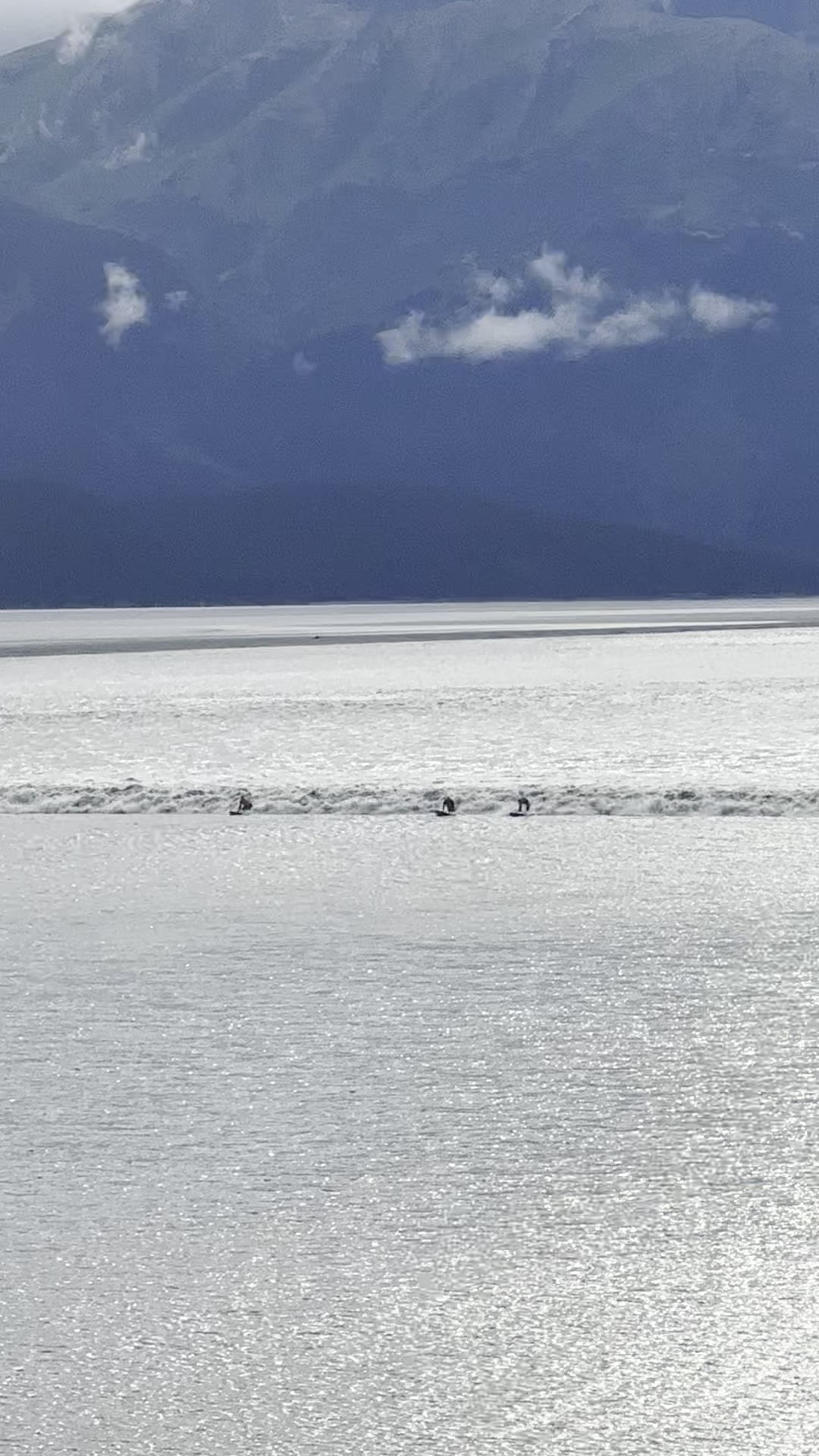
The Turnagain Arm bore tide doesn't just move water — it moves the food chain. The wave stirs bottom sediment, disorients baitfish and juvenile salmon, and creates a turbulent wake that predators have learned to exploit. Harbor seals body-surf the bore wave itself. Bald eagles hunt the churned surface behind it. Beluga whales follow the salmon runs the bore disrupts. Dall sheep watch from the cliffs above. A bore tide trip is one of the most productive wildlife-watching half-days you can spend in Southcentral Alaska.
Featured partner
Advertise to bore tide visitors
This spot reaches people actively planning a bore tide trip to Turnagain Arm. Perfect for surf schools, wetsuit rental, Girdwood lodging, guided tours, or gear shops.
Inquire → [email protected]Harbor seals — they actually surf the bore
This is the one that stops first-time visitors: harbor seals body-surf the Turnagain Arm bore. They position themselves ahead of the incoming wave, then ride it upstream for minutes at a time — diving under secondary waves and re-emerging ahead of the crest. The behavior has been documented by researchers and is observed regularly at both Girdwood Flats and Hope/Mile 13. The seals appear to use the bore to travel the arm efficiently and to access the fish disoriented in the turbulent wake. On a good bore day with seals in the water, it's one of the most unusual wildlife spectacles in Alaska.
Cook Inlet beluga whales
Cook Inlet hosts a critically endangered sub-population of beluga whales — estimated at 280–300 animals, down from over 1,300 in the 1980s. In summer, belugas sometimes follow salmon and eulachon runs into Turnagain Arm, where the bore creates feeding disruption twice daily. Adults are white and visible from shore; gray juveniles are harder to spot. Beluga Point (MP 110) is named for historical sightings, and the interpretive signs there explain the population's status. Sightings are not guaranteed but June through September offers the best odds. Don't mistake the brown silt plume of the bore for a white whale — give any pale shape in the water time to surface and blow.
Bald eagles in the bore's wake
Multiple bald eagle pairs nest along the Seward Highway corridor year-round. They've learned the bore's schedule. Watch for them perched on spruce snags and drift logs near the waterline at Bird Point and Girdwood — they position themselves downstream of the bore's predicted path and move to the shore as it passes, feeding on fish and invertebrates stranded and disoriented in the churned wake. An active feeding eagle at the bore's edge is a compelling spectacle on its own.
Dall sheep on the cliffs above
The Chugach Mountains above the Seward Highway between Potter Marsh and Girdwood host a permanent Dall sheep population — white, stocky, and visible on rock faces year-round. In summer they sometimes descend to within easy binocular range of the highway. A bore tide trip routinely delivers both wildlife on the water and Dall sheep on the cliffs above, often simultaneously. The stretch between Bird Point and Windy Corner (MP 96–100) is a reliable sheep corridor.
Salmon and the feeding cascade
Coho (silver) and chinook (king) salmon migrate through Turnagain Arm from late June through October. The bore's twice-daily turbulence mixes oxygen into the water column and disorients baitfish, triggering feeding cascades that pull eagles, gulls, and diving ducks to the bore zone. Bird Creek (MP 101) has a public salmon-viewing platform above the stream in August and September — pair a bore tide stop at Bird Point with a short walk to the platform for one of the most wildlife-dense half-days on the Kenai Peninsula.
Brown bears and moose in the corridor
Black and brown (grizzly) bears are present in the Girdwood Valley and the Portage corridor, particularly during salmon runs in fall. Moose wade the tidal marshes and riparian zones along the highway year-round and are most visible in early morning. Neither species is reliably associated with the bore itself, but driving the Seward Highway at dawn to reach your bore tide viewpoint is one of the best moose-sighting windows in Southcentral Alaska. Pull over safely and give any roadside animal space.
How to watch effectively
Arrive at your viewpoint 20–30 minutes before the predicted bore time. Scan the water surface for seals, which often appear well ahead of the bore. Set up binoculars on the cliffs for Dall sheep while you wait. After the bore passes, stay for 10–15 minutes — the post-bore feeding activity (eagles, gulls, seals) is often busier than the bore itself. The wildlife calendar: seals present most bore tides; eagles most active June–September when fish are running; belugas most likely July–August; Dall sheep lambs visible on cliffs from May.
Pro tip
A spotting scope or 8–10x binoculars transform the experience. Dall sheep and beluga whales at distance require magnification; seals riding the bore can sometimes be seen with the naked eye but close views need glass. The bore's sound gives you 3–5 minutes of warning — use it to scan the water surface for animals already in position.
More bore tide guides
Hope / Mile 13
South shore quiet — the best unobstructed bore tide view, 45 min ahead of Girdwood
Bird Point (MP 96)
The best Seward Highway pullout — wide views, parking, and minimal trail to the shore
Beluga Point (MP 110)
Closest to Anchorage — also one of the best spots to see Cook Inlet belugas
Girdwood Flats (MP 90)
The most-watched bore tide location — pullouts #4 and #5, classic Seward Highway vantage
Bore Tide Surfing Safety
What you need to know before you paddle out — gear, training, and the risks most people underestimate
How Bore Tides Work
The physics behind one of Alaska's most dramatic natural events — and how Turnagain Arm became a world-class tidal bore